Cambridge team directly images vortex-line tangle decay in a 3D potassium-39 quantum gas
Physicists at the University of Cambridge imaged vortex traces in a 3D Bose gas. The decay matches Vinen turbulence, and its coefficient is close to that of superfluid helium.
Researchers at the University of Cambridge, led by Sebastian J. Morris, directly measured the decay of a three-dimensional tangle of quantum vortex lines in a homogeneous atomic Bose gas of potassium-39, according to a paper in Physical Review Letters. aps.org
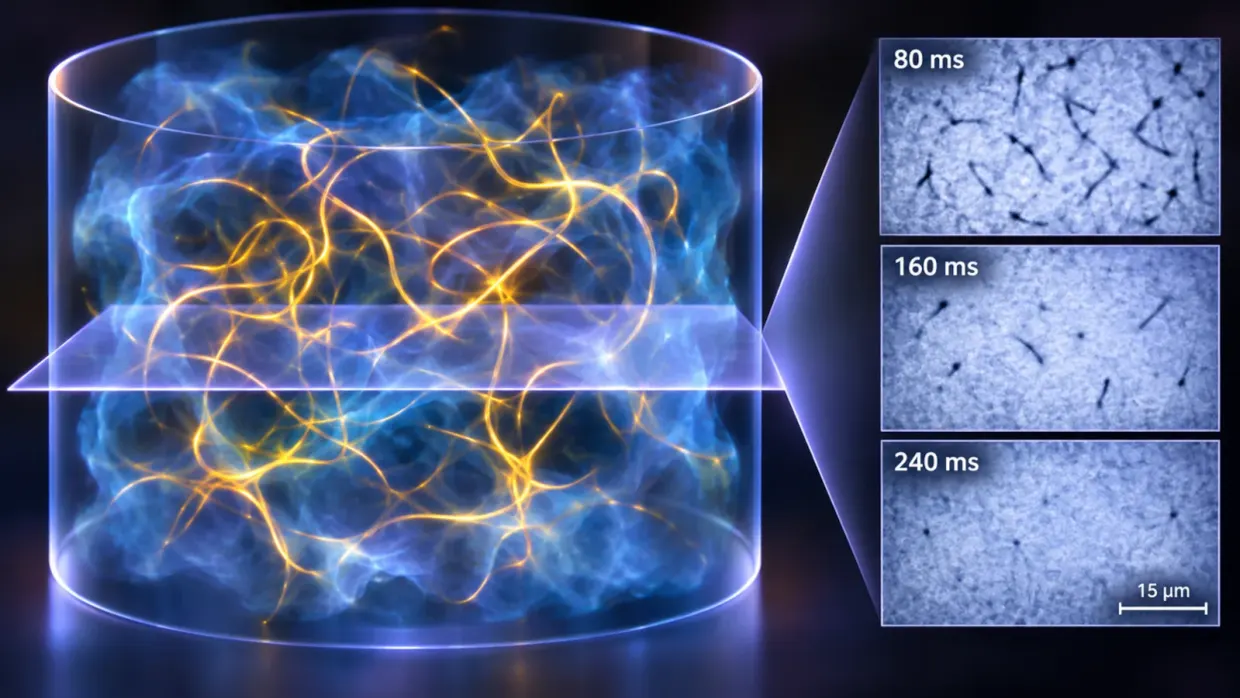
Physical Review Lettersaps.orgOpen source ↗ The atoms were held near absolute zero in a cylindrical light trap about 47 micrometers in diameter.
In quantum fluids, vortices can exist only with fixed circulation, and they form thin lines that can tangle chaotically. In Vinen turbulence the tangle gradually dissolves without large-scale flows. In superfluid helium this decay had previously been determined only indirectly, from other quantities.
How the vortices were imaged
The gas started in a disordered state and was allowed to relax toward a common ordered quantum state. To see the vortices, the team magnified the cloud about 3.5 times with a matter-wave lens and then imaged a slice about 15 micrometers thick. Where a vortex line crossed the slice, a dark trace of lower atom density appeared. Imaging the whole cloud instead of a slice left the vortices hidden.
Images from separate runs gave a statistical picture of the tangle over time. Individual traces became clearly visible after roughly 80 milliseconds, and their number then kept falling. From the number of traces the authors derived the vortex-line-length density, the total length of vortex lines per unit volume. aps.org
Physical Review Lettersaps.orgOpen source ↗
Decay law and comparison with helium
The density fell fastest at the start, when many lines were present. This matches the nonlinear decay predicted for Vinen "ultraquantum" turbulence. With very few vortices left, a slower, nearly exponential loss became noticeable; the authors suggest it may come from lines vanishing at the trap boundaries. A model including both processes fitted the data.
The measurements were repeated at three interaction strengths. At weaker interactions clear vortices appeared later, but their subsequent decay was described by the same coefficient. After accounting for the different atomic masses, the coefficient is about the same as for superfluid helium, although the potassium gas is much more dilute and its atoms interact more weakly.
The authors note that the agreement concerns the statistical decay of the line density and does not prove identical processes in all quantum fluids. The data are single slices rather than a full 3D reconstruction. Simultaneous imaging of several slices could show how the tangle changes in space and how individual vortices interact.