Hubble identifies the youngest known white dwarf companion of a millisecond pulsar in NGC 362
The helium companion of pulsar NGC 362D, about 0.18 solar masses, ended mass transfer roughly 0.6 Gyr ago and may still be surrounded by residual material.
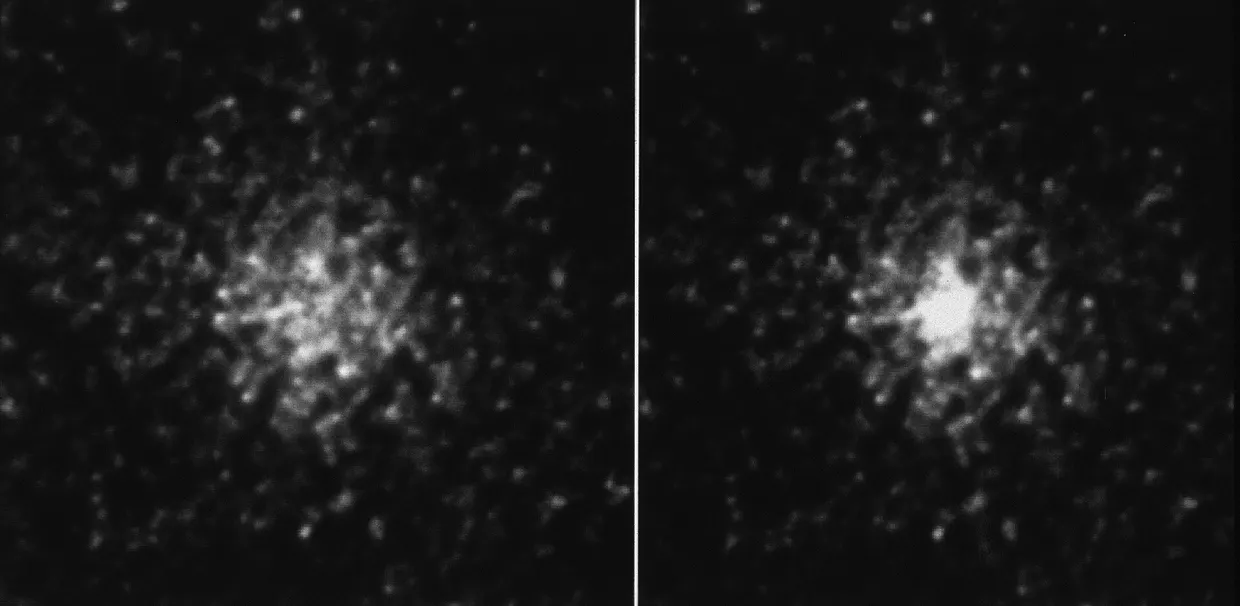
A team of researchers from Italy and Germany, led by Greta Ettorre of the University of Bologna, has identified the optical counterpart of the millisecond pulsar NGC 362D in the globular cluster NGC 362. The work, published in Astronomy and Astrophysics, relies on deep, multi-band and multi-epoch Hubble Space Telescope observations aanda.org
Astronomy and Astrophysicsaanda.orgOpen source ↗. The pulsar rotates with a period of 5.83 milliseconds. It was discovered in December 2022 in a cluster about 29,300 light years away.
A very young helium white dwarf
According to the authors, the companion, designated COM-NGC 362D, is a very low-mass (about 0.18 solar masses) helium white dwarf still in the pre-cooling phase. A comparison with updated binary evolution models indicates that it completed the mass-transfer phase only recently, about 0.6 Gyr ago. The authors conclude that this is the youngest white dwarf companion to a millisecond pulsar identified to date.
The companion was found by cross-referencing radio data on the pulsar with ten years of Hubble observations in the ultraviolet and near-infrared. The team compared the photometry with stellar evolution models to estimate the object's age and other properties.
Signs of residual circumstellar material
The photometric properties of NGC 362D show significant wavelength-dependent variations. The authors say this is the first time such variations have been seen in this class of objects, and that they are consistent with residual circumstellar material aanda.org
Astronomy and Astrophysicsaanda.orgOpen source ↗. The observed UV emission is weaker than the model predicts for a white dwarf of this kind, with larger deviations at shorter wavelengths. The authors interpret this as self-extinction by material around the proto-white dwarf, probably expelled during mass transfer. They note it is unclear whether such material could survive for this long, but it remains their preferred explanation.
The authors also report that residual material can produce radio and optical signatures similar to those of systems with non-degenerate companions. This could lead to young millisecond pulsars being misclassified. Co-author Emanuele Dalessandro of INAF says the system offers a chance to study the immediate aftermath of the recycling process, in which a companion transfers mass and angular momentum to a neutron star and spins it up to millisecond periods. According to the authors, the system can also help constrain the early evolutionary stages of proto-white dwarf companions and their radio and optical properties.