LOFAR sub-arcsecond map of the ELAIS-N1 field catalogues 62,916 radio sources over 2.5×2.5 degrees
A Leiden University-led team imaged 2.5×2.5 deg² with LOFAR at 0.33″×0.39″ resolution. According to the authors, these are the deepest radio images below 1.28 GHz.
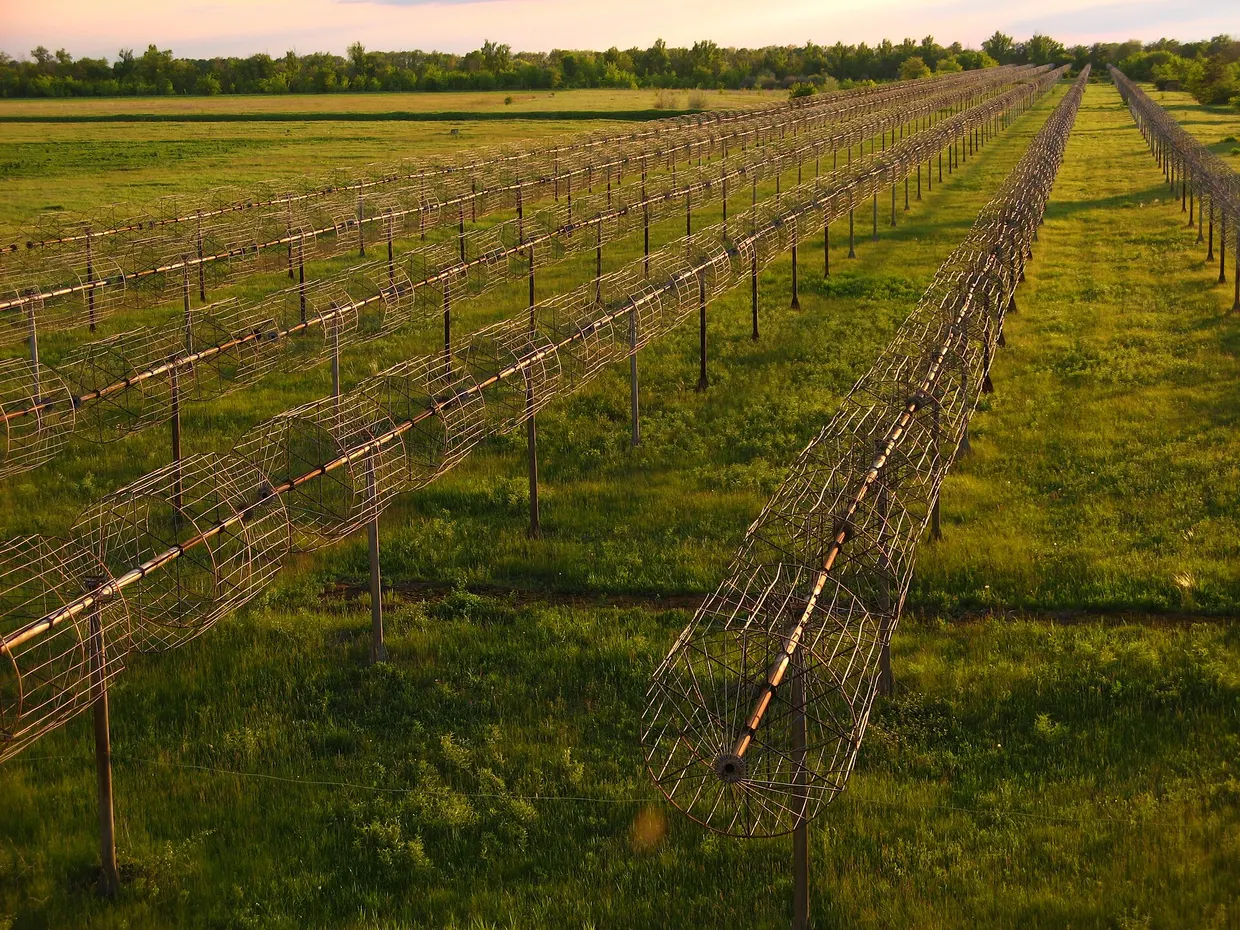
An international team led by Leiden University has produced ultra-deep sub-arcsecond radio images of the ELAIS-N1 field in the northern sky using the Low Frequency Array (LOFAR). The work is described in a paper on arXiv (Cornell University) that has been accepted by Astronomy & Astrophysics arxiv.org
arXiv (Cornell University)arxiv.orgOpen source ↗. The images cover 2.5×2.5 deg² and come from 200 hours of observations in the 115–168 MHz band. Combined with previously released 6″ LOFAR images, they give a catalogue of 62,916 unique radio sources.
Depth and resolution
The central point-source sensitivity is 5.3 µJy/beam at an angular resolution of 0.33″×0.39″. The area-weighted sensitivity is 7.4 µJy/beam at 0.36″×0.45″. The authors state that these are the deepest radio images below 1.28 GHz to date and among the deepest at any radio frequency.
According to the team, the map covers an area roughly 25 times the apparent size of the full moon. It is about 20 times sharper than the previous most sensitive LOFAR view of this region and contains approximately eight billion pixels. The observations generated roughly 400 terabytes of data.
At this resolution, separate components within the jets of active galactic nuclei can be resolved. This helps to distinguish jets powered by supermassive black holes from emission of star-forming galaxies. The image alone does not give the distance or mass of each source, so observations at other wavelengths remain necessary.
Calibration, polarisation and processing
The images use recent advances in LOFAR long-baseline calibration and imaging arxiv.org
arXiv (Cornell University)arxiv.orgOpen source ↗. Astrometric alignment with 95 Gaia quasars gives positional offsets of ΔRA = −3 ± 27 mas and ΔDEC = 2 ± 17 mas for these sources.
The authors also demonstrate the potential for deep polarisation studies at sub-arcsecond resolution. Instrumental leakage from Stokes I into linear polarisation is as low as 0.12%, about a factor of two better than typical leakage in the LOFAR Two-metre Sky Survey at 6″ resolution.
The researchers report that they reduced the processing cost by more than a factor of ten compared with earlier methods. The observations were processed over several months on the Spider computing platform hosted by SURF in the Netherlands. The observations are publicly available, so other teams can combine them with data from other telescopes.
According to the authors, imaging many observations over a wide field at sub-arcsecond resolution is now computationally feasible. They describe the result as a new benchmark for low-frequency radio imaging in depth, resolution and survey area, and as a foundation for deeper and wider surveys in the LOFAR2.0 and SKA era arxiv.org
arXiv (Cornell University)arxiv.orgOpen source ↗.