Prokhorov GPI RAS review of biomaterials for photonic chips: waveguide loss of 0.24 dB/cm
A review of earlier lab work describes proteins, DNA and other biomaterials as light guides, emitters and converters; medical sensors look most promising, but integration is hard.
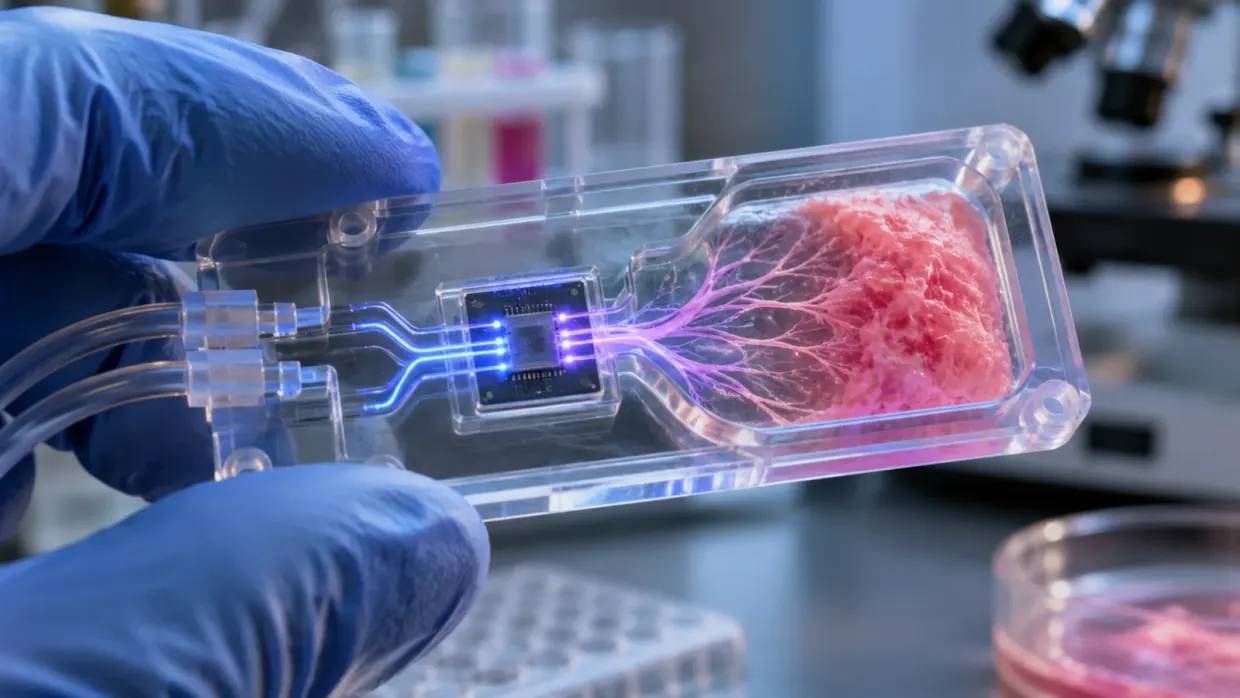
Researchers led by Petr I. Nikitin of the Prokhorov General Physics Institute of the Russian Academy of Sciences (GPI RAS) in Moscow have compiled the state of research on biology-based photonics, scinexx reports. scinexx.de
scinexxscinexx.deOpen source ↗ The perspective paper evaluates earlier laboratory results and technical options. It does not present a new experimental test of a fully integrated light chip.
Photonic circuits transmit information with light, but they still rely mostly on rigid inorganic semiconductors, which connect poorly to soft and living tissue. The authors consider supplementing conventional chips with biological components rather than replacing them.
Components reviewed
Optical waveguides made of silk proteins or special DNA complexes can guide light through thin structures. For biopolymer waveguides the review cites a low loss of 0.24 dB per centimetre, a best value from previously published individual experiments. It does not demonstrate the performance of a complete biophotonic processor.
For biohybrid light-emitting diodes, the overview reports luminous efficacy of up to 130 lumens per watt and operating times of more than 3,600 hours. scinexx.de
scinexxscinexx.deOpen source ↗ Another approach combines light-sensitive proteins with carbon nanotubes or graphene; the optical response of such hybrids depends on the absorption properties of the biomolecules. The review also describes biohybrid solar cells with efficiencies of about 20 percent and optoelectronic memristors, which retain information about earlier electrical or optical states.
Medical use and limits
Biological materials may be compatible with living tissue, and their optical properties can be tuned. Conceivable uses are wearable diagnostic systems, implantable sensors and examinations at the patient's side. The laboratory demonstrations do not yet show that such systems have been clinically tested or are reliable over the long term.
Many biomolecules are sensitive to heat and to the harsh processing steps common in chip manufacturing. Stability, charge transfer and the joining of different material surfaces may also limit performance. The article therefore sees biomaterials as a specialised addition to established semiconductors rather than a basis for whole chips. It names reproducible manufacturing methods, shared testing standards and reliable interfaces between biological layers and technical components as requirements.
Whether robust, economically producible light chips for medicine can result remains open. The environmental benefit of biopolymers from renewable raw materials is also not yet shown for chip production as a whole. scinexx.de
scinexxscinexx.deOpen source ↗