First concrete poured for Chilong-1 gas-cooled reactor at China's Xuwei plant, steam for refineries
The Xuwei complex pairs Hualong One and high-temperature gas-cooled Chilong-1 reactors to deliver 32.5 million tonnes of steam a year to petrochemical plants.
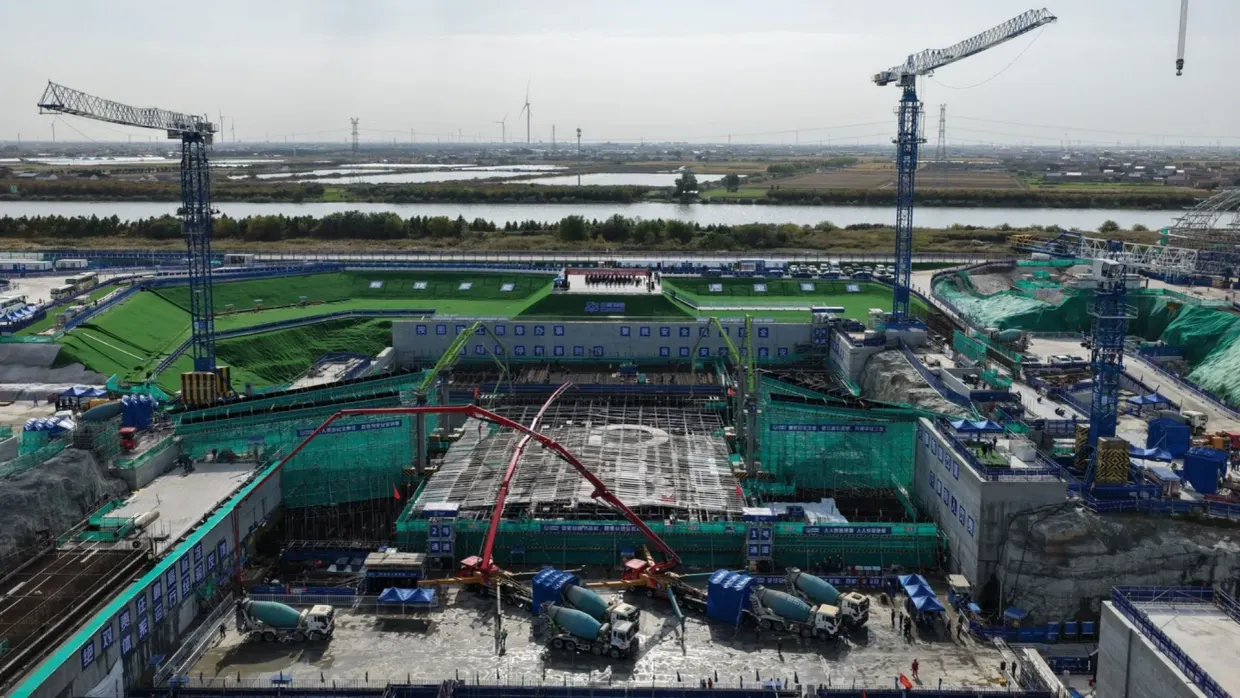
Workers have poured the first concrete for the nuclear island at the Xuwei plant in Jiangsu province, China. The milestone marks the start of construction of what is described as the world's first commercial Chilong-1 reactor, Interesting Engineering reports. interestingengineering.com
Interesting Engineeringinterestingengineering.comOpen source ↗ The site is managed by China Nuclear Power Investment, a subsidiary of CNNC. Its first phase includes two Hualong One reactors and one Chilong-1 unit; work on the first Hualong One began on 16 January.
Industrial steam first, electricity second
Unlike conventional nuclear sites built almost exclusively for the grid, the Xuwei complex will function primarily as an industrial steam supplier. It will deliver heat directly to nearby petrochemical refineries and send surplus electricity to the regional network.
Once fully operational, the first phase will provide 32.5 million tonnes of industrial steam per year and generate over 11.5 billion kilowatt-hours of electricity. Replacing fossil fuels is expected to cut standard coal use by 7.26 million tonnes a year. According to official estimates, this will prevent nearly 19.6 million tonnes of carbon dioxide emissions annually.
Two reactor types working in sequence
The plant combines two technologies on one site: Hualong One pressurized water reactors and the Chilong-1 high-temperature gas-cooled reactor. Main steam from the third-generation Hualong One first turns demineralized water into saturated steam. The fourth-generation Chilong-1 then superheats that steam, yielding three grades of high-temperature steam tailored for petrochemical refining. interestingengineering.com
Interesting Engineeringinterestingengineering.comOpen source ↗
To run the tandem, operators will use a unified "reactor-machine-heat" coordinated control architecture. It is the first time a commercial facility has operated both reactor types under a single integrated heat-delivery framework.
The Chilong-1 was jointly developed by China National Nuclear Corporation (CNNC) and Tsinghua University. It is based on fourth-generation principles that emphasize passive safety: the reactor is designed to remain safe during severe system failures without operator intervention or external power, and, by design, the physics of the core prevents a meltdown even after complete coolant loss.
The layout is modular. Individual units produce relatively modest power, and several modules can be linked depending on regional needs. The high core temperatures also make the reactor suitable, according to the report, for large-scale hydrogen production and efficient power generation. When completed, the plant is to serve as a permanent low-carbon heat and power source for the Lianyungang petrochemical industrial base. interestingengineering.com
Interesting Engineeringinterestingengineering.comOpen source ↗