EVdesign yields over 400 active PET hydrolases with 12–68 substitutions from 603 tested designs
Evolution-informed and rational design were combined to engineer PET hydrolases; in vitro, many variants approached the LCC-ICCG benchmark in partial conversion.
A research team reported in Nature Communications a combination of evolution-informed design (EVdesign) and rational design for engineering poly(ethylene terephthalate) (PET) hydrolases, enzymes that depolymerize PET nature.com
Nature Communicationsnature.comOpen source ↗. Overall, the authors experimentally tested 603 designs derived from eight parent PETases. More than 400 variants carrying 12–68 amino acid substitutions depolymerized PET, nearly all outperformed their parent enzymes, and many approached the benchmark LCC-ICCG in partial conversion assays.
Enzymatic depolymerization is considered a route for recycling PET to its monomers. According to the authors, industrial use is hindered by the need for pH control and by low activity on highly crystalline PET. Earlier engineering of PETases mostly relied on rational design, enzyme discovery or directed evolution, each introducing a relatively small number of mutations at a time.
How EVdesign works
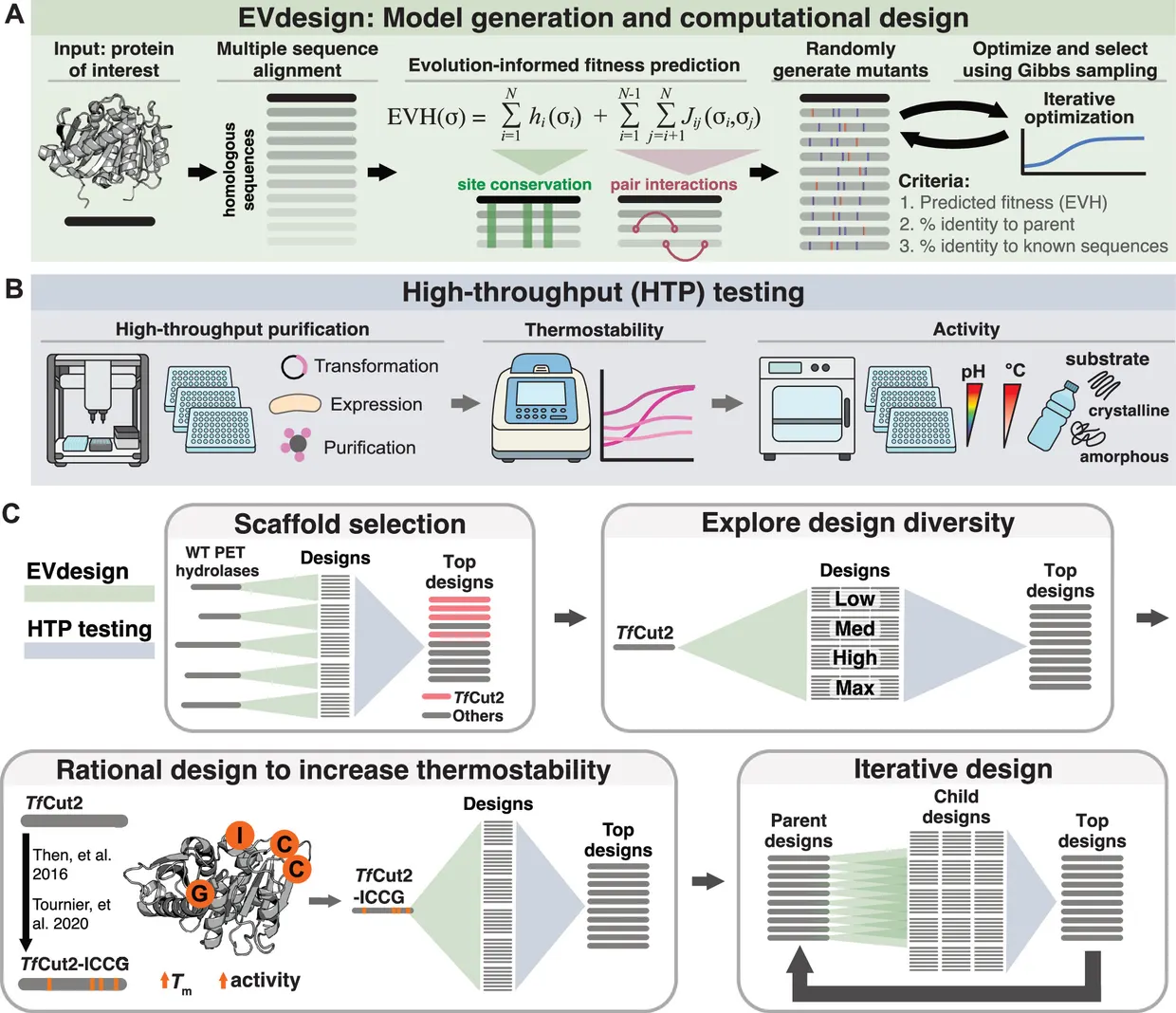
EVdesign uses patterns of amino acid co-variation in multiple sequence alignments of homologous proteins, modeled with EVcouplings, to propose coordinated sets of mutations that should not disrupt structure or activity. Variants were produced and tested in a high-throughput pipeline: a semi-automated expression and purification platform with a liquid-handling robot. Thermostability and PET hydrolysis were assessed on amorphous and crystalline PET, at different pH values and temperatures.
Scaffold choice and iteration
Designs derived from different parent enzymes differed strongly in success rate and performance. TfCut2 from Thermobifida fusca emerged as the most design-amenable scaffold nature.com
Nature Communicationsnature.comOpen source ↗. Greater sequence diversification reduced the number of active enzymes but widened the spread of performance, which made it possible to find high-performing outliers.
Four rational mutations overcame a thermostability bottleneck in TfCut2. This variant served as a scaffold for iterative EVdesign, which further improved activity. The data come from laboratory assays with purified enzymes; the authors present EVdesign as a robust strategy for generating diverse, high-activity enzymes.