Broccoli under magenta cadmium telluride solar panels matured 25 days later in a Swedish field trial
Semi-transparent panels passing 13.2% and 19.2% of photosynthetically active light delayed maturity, but fresh biomass matched open-field plants.
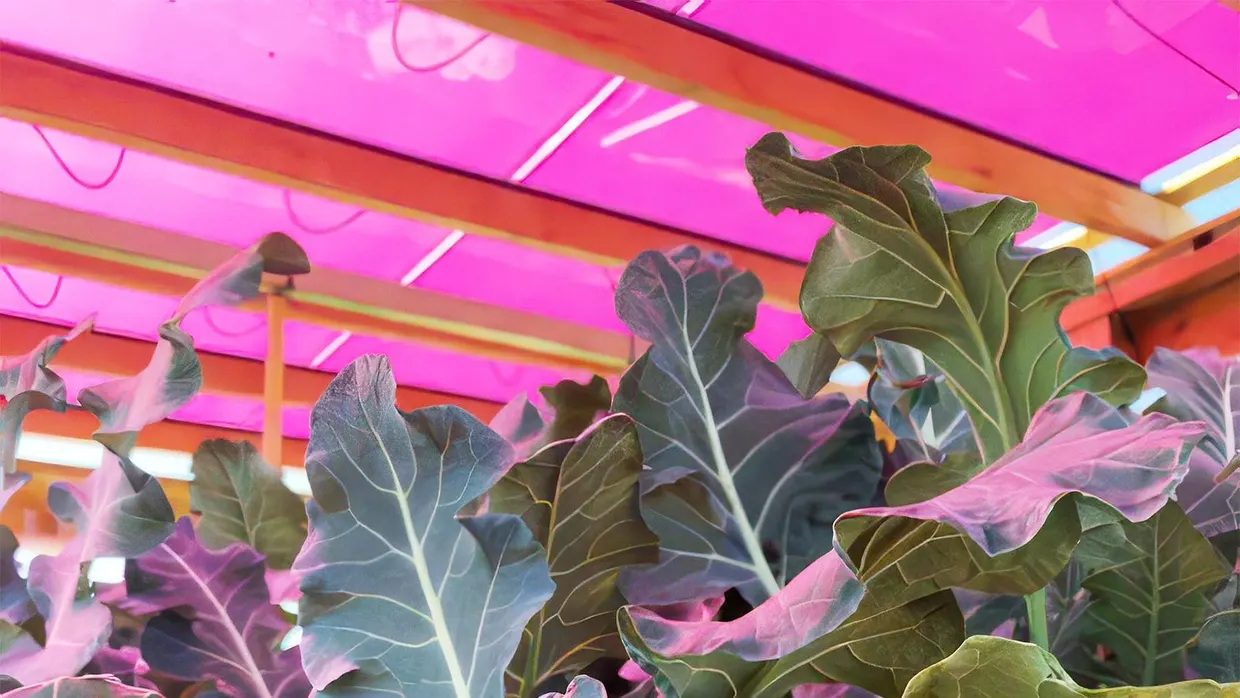
Researchers at Mälardalen University in Västerås, Sweden, together with colleagues from two Italian institutes, grew broccoli under semi-transparent magenta cadmium telluride photovoltaic panels in an outdoor field trial. The results were published in Cell Reports Physical Science sciencedirect.com
Cell Reports Physical Sciencesciencedirect.comOpen source ↗. Seedlings were planted on July 2, 2024, at the Kärrbo Prästgård farm in central Sweden, 44 plants per plot. The two panel designs transmitted on average 13.2% and 19.2% of photosynthetically active radiation.
Field setup and light
The team built two canopies, each about 4 by 5 m and 1.5 m tall at the low edge. The magenta panels were designed to pass the wavelengths favorable for broccoli growth. The manufacturer rated the panels as 50% and 70% transparent. A third, open plot served as the control.
Afternoons under the panels were about 1.0 °C warmer than in the open plot, and nights about 1.1 °C cooler. Air humidity under the canopies was about 6% higher.
Growth, nutrients and electricity
Reduced light delayed crop maturity by 25 days sciencedirect.com
Cell Reports Physical Sciencesciencedirect.comOpen source ↗. Open-field broccoli was ready to cut after 79 days, while plants under the panels were smaller and were left to grow. By day 104, heads under both canopies weighed about the same as open-field heads at day 79. According to the authors, fresh biomass under the systems was comparable to open-field plants, and radiation use efficiency rose by up to 4.5 times.
Concentrations of most macronutrients remained unchanged, while micronutrients decreased, which the authors link to altered nutrient dynamics under modified light and microclimate. At the first sampling, iron in shaded heads was 37–41% lower than in open-field heads, manganese 38–42%, zinc 18–20% and copper 12%.
The denser canopy was estimated to generate 447.6 kWh over the season from panels rated at 1.1 kW, converting 7.2% of incident sunlight to electricity.
The study has clear limits. Each treatment had one plot and six sampled plants over a single season in central Sweden. The authors state that the findings are specific to these conditions and need validation across a broader range of seasons and system configurations sciencedirect.com
Cell Reports Physical Sciencesciencedirect.comOpen source ↗. Lead author Silvia Ma Lu said that configurations similar to the prototype may currently suit smaller-scale uses, such as community gardens or greenhouse roofs, rather than large agricultural areas.