Akiapolaau honeycreeper uses ankle-driven strikes and asymmetric beak to forage in wood
An anatomical study reveals that the endangered Hawaiian honeycreeper relies on ankle dorsiflexion and a specialized dual-purpose beak to gouge wood.
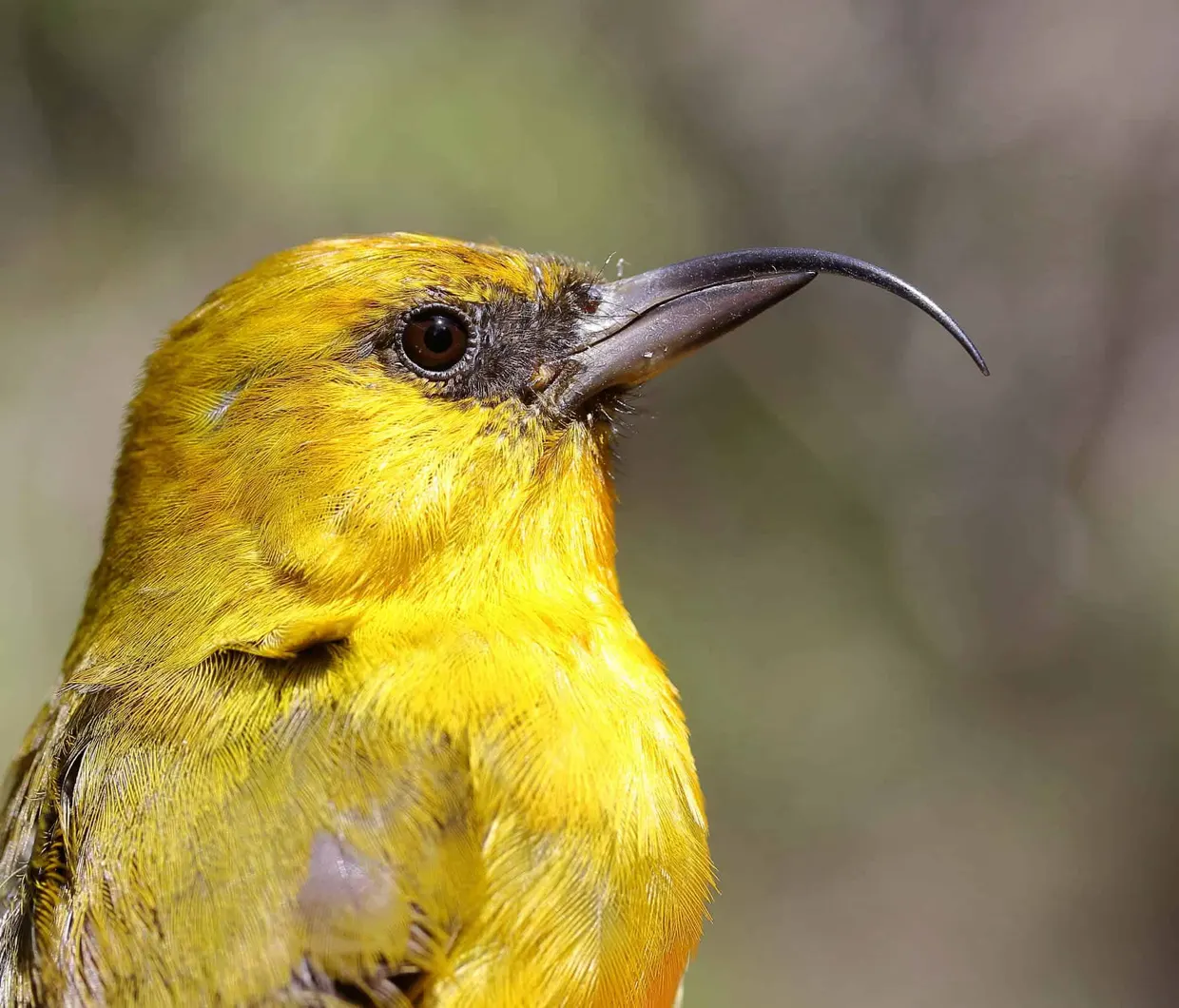
The Hawaiian honeycreeper known as the ‘akiapōlā‘au (Hemignathus wilsoni) uses a combination of an asymmetric beak, reinforced ankle joints, and a shortened femur to fill an ecological niche similar to woodpeckers, according to an anatomical study published in The Auk oup.com
The Aukoup.comOpen source ↗. Researchers analyzed museum skeletal specimens to investigate how this island bird independently developed wood-gouging mechanics without the specialized neck anatomy found in continental woodpeckers.
Dual-function beak mechanics
The bird's upper and lower bills serve distinct functional roles. The short, stout lower bill acts as a chisel to gouge into woody substrate, while the elongate, down-curved upper bill serves as a probe to extract invertebrate prey. Osteological examination showed that the bony core of the upper rostrum is roughly 38% shorter than the overlying keratin sheath (rhamphotheca), creating structural flexibility at the tip that prevents breakage during deep probing.
Skeletal adaptations for full-body leverage
Unlike woodpeckers, which primarily drive impacts with head and neck musculature, H. wilsoni recruits its entire body during strikes. Morphological analysis showed modified muscle insertions on the lower leg that indicate strengthened dorsiflexion of the ankle joint relative to other cardueline finches. This ankle movement helps propel the bird's mass into each strike.
Additionally, the femur is proportionally short and robust compared to continental relatives, mirroring skeletal adaptations seen in woodpeckers oup.com
The Aukoup.comOpen source ↗. This geometry lowers the bird's center of mass against perches, stabilizing the torso during mechanical gouging. According to researchers, fewer than 2,000 individuals of this endangered species remain on Hawaiʻi Island, facing pressures from habitat loss and mosquito-borne avian malaria.