Columbia's stroboSCAT microscope separates single- and multi-particle transport in semiconductors
Intensity cycling in a transient scattering microscope lets researchers image single-particle and multi-particle transport separately in van der Waals semiconductors, the authors report.
Chemist Milan Delor at Columbia University and colleagues have extended the stroboSCAT microscope so that it distinguishes single-particle from multi-particle quantum states of energy carriers. The results were published in Nature Materials nature.com
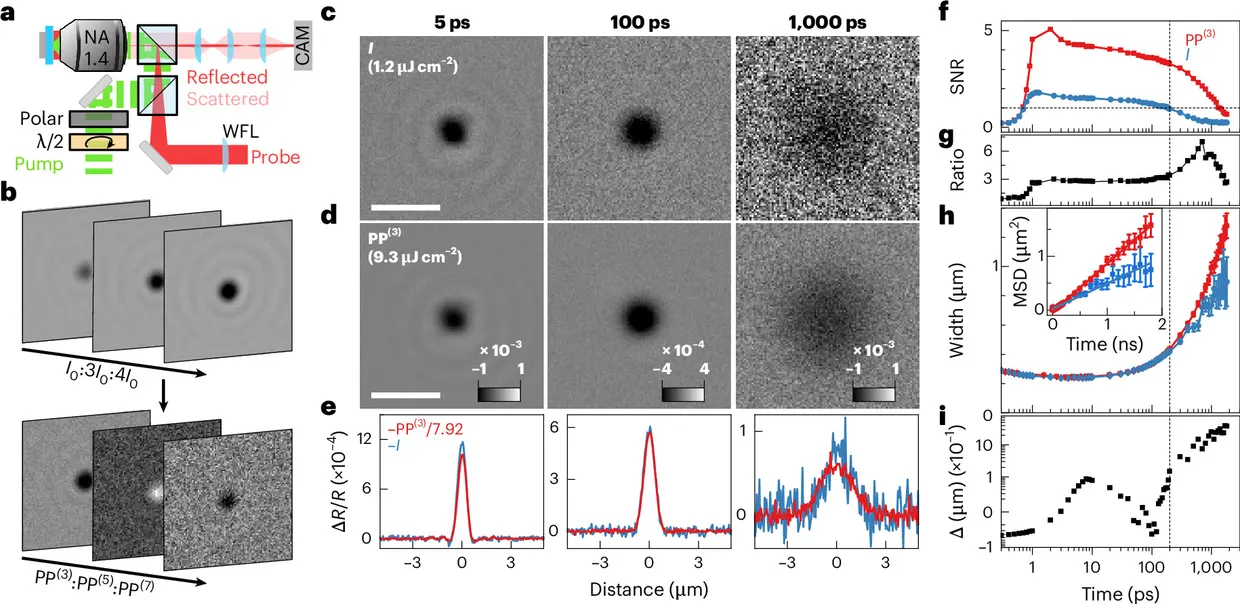
Nature Materialsnature.comOpen source ↗. The authors used transient scattering microscopy on van der Waals semiconductors and applied intensity cycling, a concept from multidimensional spectroscopy, to the spatiotemporal domain.
Spatiotemporal optical microscopies already image the propagation of electrons, excitons, magnons and polaritons. They give functional metrics that contact-based transport measurements cannot reach. However, they do not distinguish single-particle from multi-particle states, which hinders the study of many-body correlations.
Intensity cycling and resolution
According to the science.mail.ru report on the work, cycling the light intensity isolates individual quantum states even at low carrier density and avoids interference from many-body interactions. The same report says the new version of stroboSCAT reaches femtosecond time resolution and spatial resolution of a few nanometers. The team followed electrons moving through a two-dimensional semiconductor and tracked how two- and three-particle states evolve.
What the method imaged
The paper demonstrates several capabilities. These are clean isolation of single-particle charge transport with a high signal-to-noise ratio, spatiotemporal tracking of exciton-exciton annihilation, and high-throughput mapping of dielectric disorder nature.com
Nature Materialsnature.comOpen source ↗. The method also imaged the emergence of a polaronic Mott transition and correlated transport in a superatomic solid.
The authors describe the result as a precision tool for visualizing how many-body interactions shape material function. According to the report, Delor shares the stroboSCAT blueprints and software so that other laboratories can adopt the method.