Yonsei and Ghent teams find a hidden melanosome layer behind magenta in Anna's hummingbird feathers
Microscopy and simulations show the blue peak of the non-spectral magenta in Anna's hummingbird feathers arises from interaction of the top and middle melanosome layers.
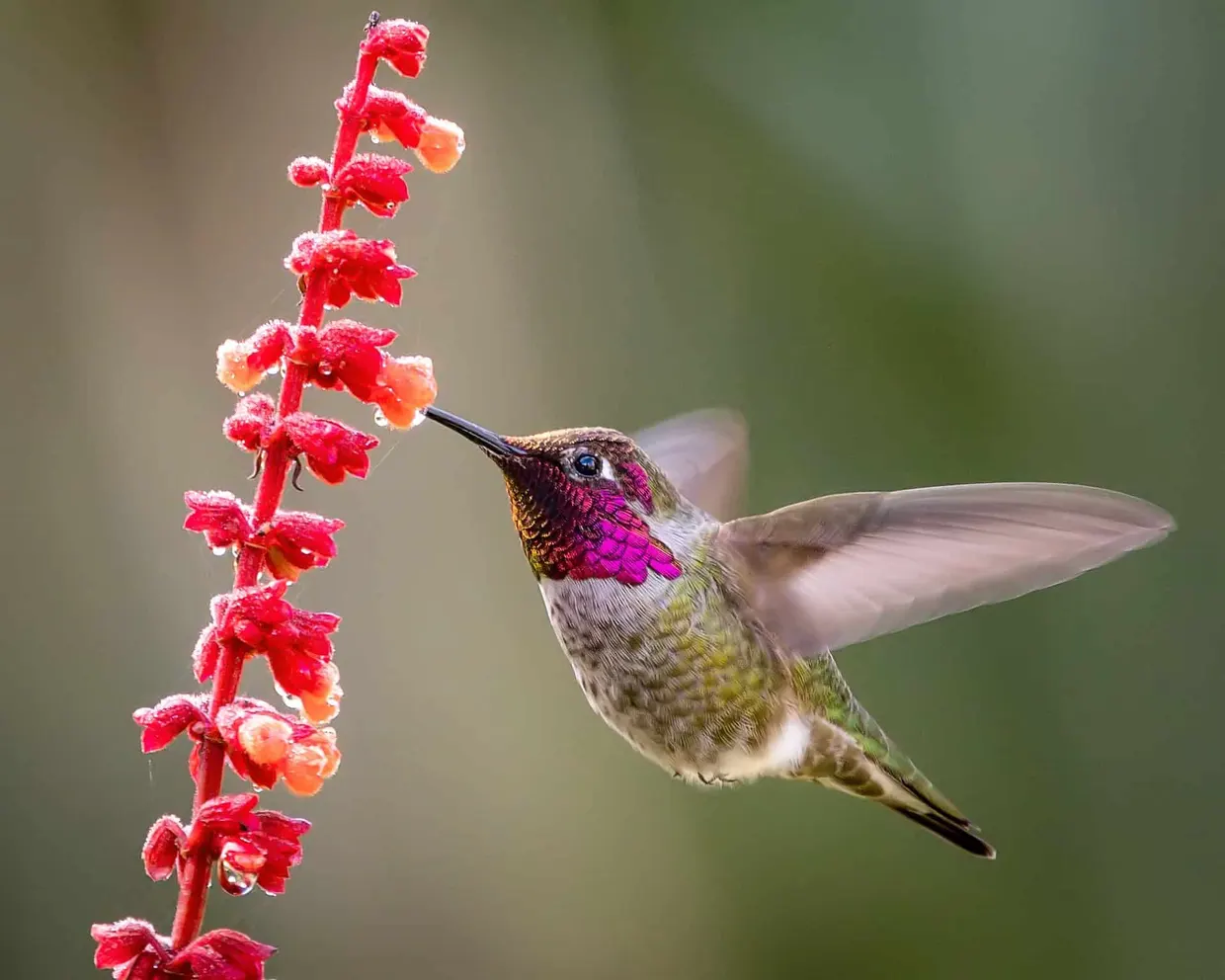
Researchers from Yonsei University in South Korea and Ghent University in Belgium have described a previously uncharacterized intermediate-sized melanosome layer in the gorget feathers of Anna's hummingbird (Calypte anna). According to the paper in the Journal of The Royal Society Interface, this layer explains the secondary blue reflectance peak of the bird's magenta colour doi.org
Journal of The Royal Society Interfacedoi.orgOpen source ↗. The reflectance spectrum has a dominant red peak at about 632 nanometers, which is nearly three times stronger than the blue one.
Magenta is a non-spectral colour: it has no single wavelength and arises from a combination of red and blue light. In hummingbird feathers, colour comes from light interference in multi-layered arrays of platelet-shaped melanosomes embedded in corneous beta-protein. The red peak had earlier been attributed to the melanosome stack, but the origin of the blue peak remained unexplained.
Melanosome size gradient in the barbule
Electron microscopy and tomography showed a continuous gradient of melanosome size across the depth of the barbule. At the surface lies one small melanosome layer, below it two intermediate-sized layers, and deeper still progressively larger melanosomes. Reported average thicknesses are 108 nanometers for the surface melanosomes, about 189 nanometers for the intermediate ones and 222 nanometers for the larger, deeper ones.
The authors describe the structure as a multi-periodic multi-layer reflector, in which the intermediate layer plays an essential role in forming the blue peak doi.org
Journal of The Royal Society Interfacedoi.orgOpen source ↗.
Simulations and plasma etching
Optical simulations indicate that the blue peak depends on the interaction between the top and middle layers, while the deeper multi-layer strengthens and sharpens the dominant red peak through interference. According to the simulations, neither the surface layer nor the intermediate layer produces the blue peak on its own.
The team tested this with oxygen plasma etching. Removing the superficial layer eliminated the blue peak. After 60 seconds of treatment the colour shifted toward reddish-orange, and after 120 seconds the feathers looked yellowish-orange. The red peak also moved toward shorter wavelengths.
The authors conclude that the non-spectral magenta arises from hierarchical optical interactions across a graded melanosome architecture. They propose this as a biomimetic design principle for non-spectral reflectors doi.org
Journal of The Royal Society Interfacedoi.orgOpen source ↗. The first author of the study is Sangyeop Kim.