Cambridge model shows comets delivered 8.5 times more intact HCN to Mars than Earth
Numerical simulations reveal that atmospheric entry and impact pyrolysis destroy most prebiotic hydrogen cyanide delivered to Earth, while Mars preserves significantly more.
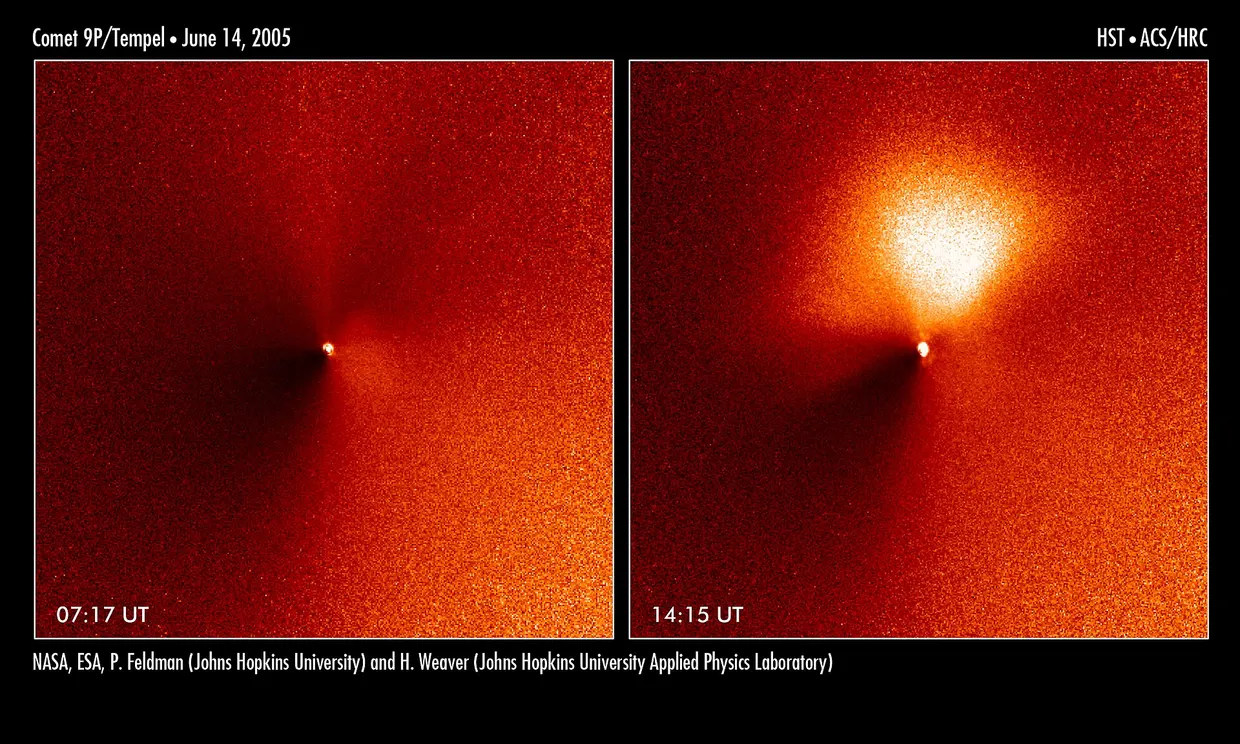
Specialists from the Institute of Astronomy and the Cavendish Laboratory at the University of Cambridge modeled the delivery of hydrogen cyanide (HCN) to early Earth, Mars, and Venus, as reported by Naked Science based on a preprint on arXiv.org. Comets originating from the Kuiper Belt were simulated during atmospheric entry and planetary impact between 4.2 and 3.8 billion years ago. The goal was to quantify the surviving concentrations of HCN, a fundamental precursor for purine bases like adenine (C₅H₅N₅) naked-science.ru
Naked Sciencenaked-science.ruOpen source ↗.
Atmospheric destruction and oceanic dilution
The simulations revealed three major mechanisms preventing prebiotic synthesis on early Earth. All comets smaller than 100 meters completely fragmented high in the atmosphere, dispersing molecules across vast areas. Larger impactors primarily struck the global ocean, diluting the preserved compound. Impacting land caused severe pyrolysis, thermally degrading even heat-resistant HCN molecules upon collision. Ground-water influx into newly formed craters further diluted any surviving organic matter.
Calculations show cometary bombardment delivered roughly 26.5 billion metric tons of intact HCN to Earth. Spread throughout the ocean, this mass yields a concentration of just 0.75 micromoles per liter. This value is several orders of magnitude below the minimum 10 millimoles per liter threshold necessary to initiate prebiotic chemical pathways.
Comparative dynamics across terrestrial planets
Identical bombardment models applied to Venus and Mars revealed contrasting outcomes. The dense atmosphere of Venus completely obliterates multi-kilometer comets before impact. Conversely, the rarefied atmosphere and lower gravity of Mars allowed 8.5 times more cometary bodies carrying sufficient quantities of intact HCN to reach the surface compared to Earth naked-science.ru
Naked Sciencenaked-science.ruOpen source ↗.
These findings suggest that planetary conditions on Mars were statistically more favorable for cometary organic delivery than Earth. However, researchers noted this Martian scenario reflects modern atmospheric parameters, whereas ancient Mars likely hosted a denser atmosphere and surface liquid water.