Delft researchers flip the nuclear spin of a single atom with radio waves in a scanning tunneling microscope
A Delft University of Technology team flipped the nuclear spin of a single atom even when it was largely disentangled from the electron spin, contrary to the authors' expectations.
Researchers at Delft University of Technology used radio waves to control the magnetic spin of a single atomic nucleus, SciTechDaily reports. The experiment was led by Sander Otte, with Hester Vennema as lead author, and was published in Nature Communications on 24 October 2026. According to the authors, the nuclear spin responded under conditions where they did not expect it to. scitechdaily.com
SciTechDailyscitechdaily.comOpen source ↗
Nuclear magnetism is much weaker than the magnetism of electrons, but it is better shielded from the outside world, Otte said. Some atoms have a nucleus that carries a spin. Earlier experiments mostly examined electron spin, which is easier to detect and manipulate.
Two signals on one atom
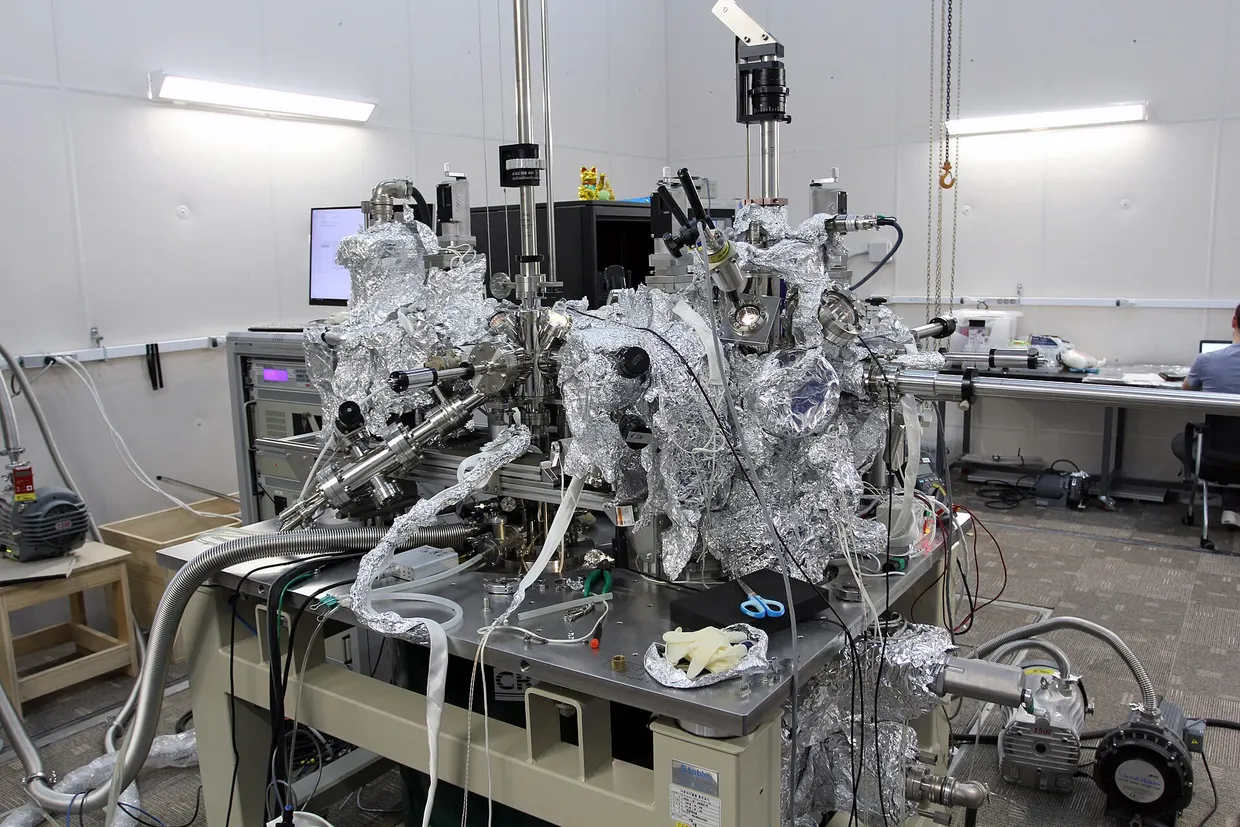
The team works with a modified scanning tunneling microscope that can direct electrical signals at individual atoms. Until now, nuclear spin could be observed only indirectly, through the hyperfine interaction, a quantum coupling between the magnetic properties of an electron and the nucleus.
Vennema and her colleagues applied two signals at the same time, one targeting the electron and one targeting the nucleus. To do this, they adapted double magnetic resonance, an established technique, to work with a single atom. The method lets the nucleus and the electron be addressed independently, with signals tuned to their respective magnetic resonances. scitechdaily.com
SciTechDailyscitechdaily.comOpen source ↗
In quantum mechanics, spin changes between specific allowed states, and each transition requires a signal of the appropriate frequency. Vennema compared this to guitar strings: each possible spin rotation has its own note. According to her, the notes of a nuclear spin are a hundred to a thousand times lower than those of an electron spin.
An unexpected response
By examining the effects of the two signals separately, the researchers found that they could flip the nuclear spin even when it was largely disentangled from the electron spin. This contradicted their expectation that the nucleus would not respond independently to the microscope's electrical signals. "According to our simple understanding, this should not really happen," Otte said.
The physical mechanism remains unknown. The coupling between the nuclear and electron spins is not sufficient to explain the observed behavior, and the authors say further investigation is needed. scitechdaily.com
SciTechDailyscitechdaily.comOpen source ↗
Nuclear spins are considered promising candidates for storing quantum information, because they are relatively well protected from external disturbances that can disrupt delicate quantum states. Control of an individual nuclear spin could eventually support new methods for storing and reading such information, although practical applications remain a future possibility.