University of Bristol Model Shows Early Earth Had Flattened Shape and 2-Hour Days
A new geophysical simulation shows that rapid rotation after the Moon-forming impact deformed early Earth into an oblate spheroid, shaping its initial crust.
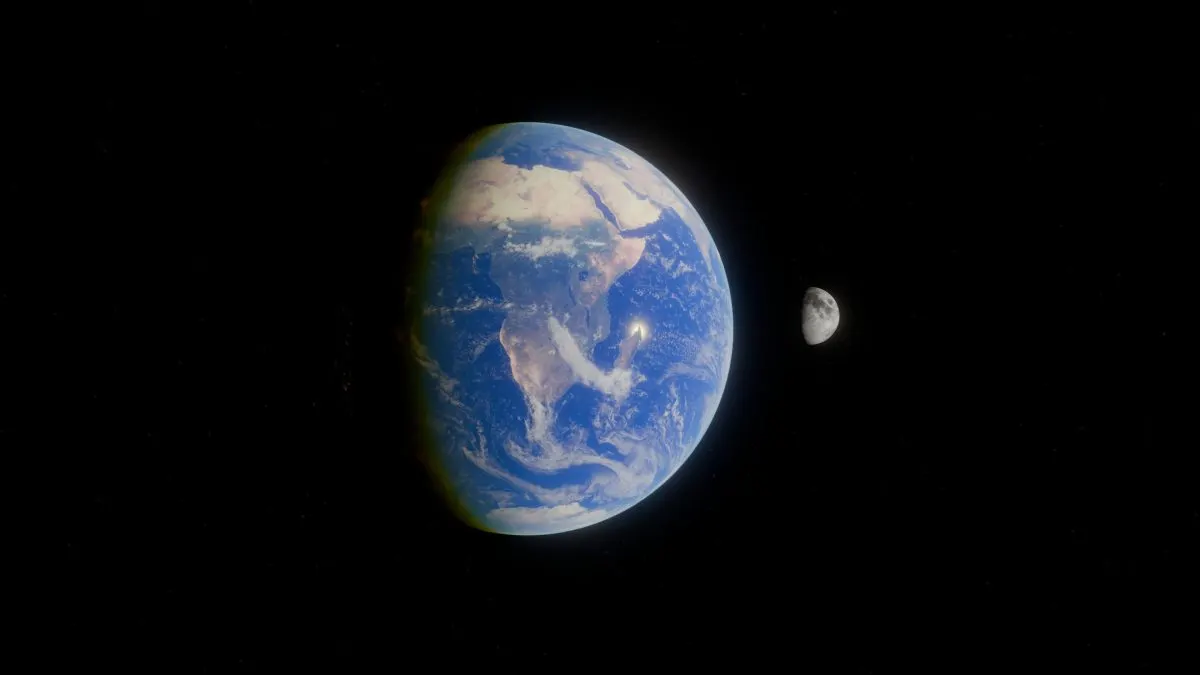
Immediately after the giant impact that formed the Moon, Earth likely possessed a highly flattened oblate shape and rotated at extreme speeds, according to a study by Simon Lock from the University of Bristol published in the Journal of Geophysical Research: Solid Earth and reported by Universe Magazine universemagazine.com
Universe Magazineuniversemagazine.comOpen source ↗. The findings indicate that these conditions largely dictated early crustal formation.
According to the proposed model, the planetary day lasted only between 2 and 5 hours shortly after the collision. Under the influence of intense centrifugal forces, the cooling planet bulged dramatically at the equator while flattening at the poles. In several computed variations of the model, Earth's equatorial radius was twice as large as its polar radius, giving the planet a pumpkin-like geometry.
Crustal stress and deformation
Because of this extreme rotation, stresses within the cooling crust were immense. While the primordial crust was likely not partitioned into modern tectonic plates, the mechanical tension and compression reached levels comparable to the forces that eventually formed the Himalayas. The research notes that as the Moon gradually receded and the planet's rotation decelerated over tens of millions of years, Earth slowly rounded, causing the crust to stretch at the poles and compress near the equator.
Limitations and preserved signatures
The author emphasizes that the study is based strictly on numerical simulations rather than direct petrological samples, as Earth's original primordial crust has been completely recycled by subsequent geological activity. However, ancient relict fragments in modern cratons exhibit notable chemical and lithological diversity universemagazine.com
Universe Magazineuniversemagazine.comOpen source ↗. The researcher suggests that incorporating rotational dynamics into future models will clarify the mechanisms behind the genesis of Earth's first stable continents.