Ames Lab: right- and left-handed magnon bands in TbMn6Sn6 and ErMn6Sn6 ferrimagnets cross and mix
Researchers at Ames National Laboratory report that magnon bands of opposite handedness cross in RMn6Sn6 ferrimagnets and can be gapped by changing the magnetic order or applying a field.
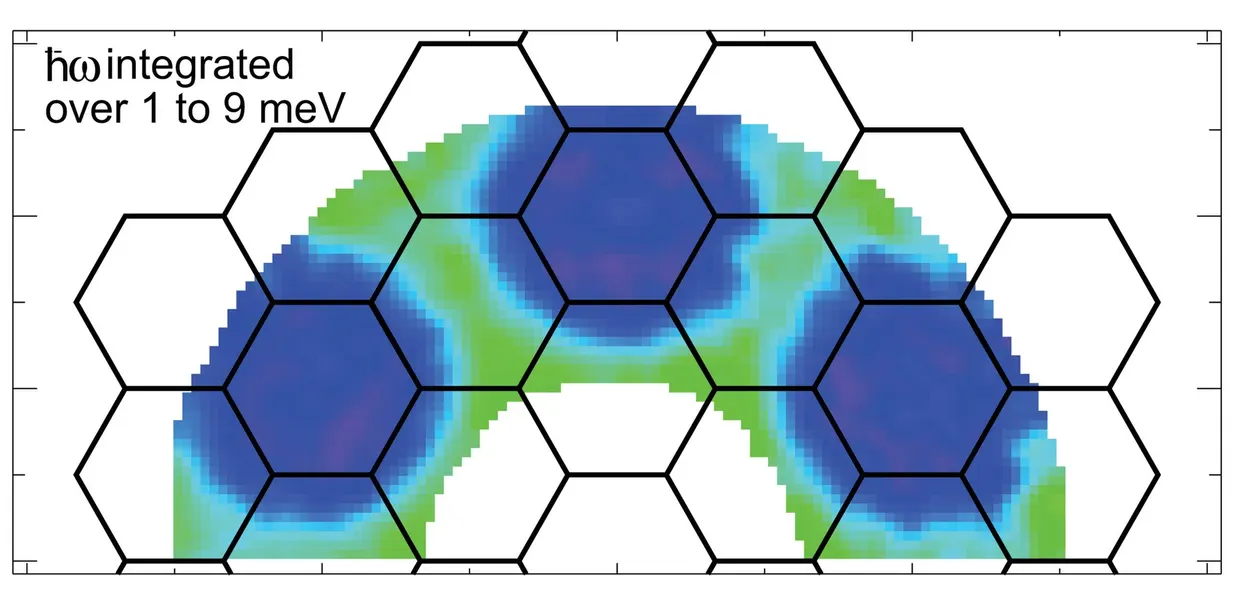
Researchers at the U.S. Department of Energy's Ames National Laboratory, in the group led by Rob McQueeney, report that magnons of opposite handedness can be made to mix in ferrimagnets of the RMn6Sn6 family (R = Tb, Er). The work is published in Physical Review Letters under the title "Chiral Magnon Mixing by Symmetry-Breaking in Collinear Ferrimagnets" aps.org
Physical Review Lettersaps.orgOpen source ↗. According to the authors, it gives a way to control the handedness of magnons, which are studied as carriers of information that do not move electrical charge.
Magnon handedness in ferrimagnets
In ferromagnets, the spin angular momentum of a magnon is defined by right-handed precession of the moment around the magnetization direction. In antiferromagnets with no net magnetization, left- and right-handed magnons have the same energy when no field is applied. Ferrimagnets contain two types of magnetic atoms with oppositely directed moments of unequal size, so the moments do not cancel completely.
Such materials should natively host both right- and left-handed magnons, with their energies split by the internal molecular field. The group came to the question while studying magnetic excitations in kagome metals, a class of quantum materials with unusual magnetic behavior. They observed that magnons in TbMn6Sn6 cross without interacting, while in ErMn6Sn6 they interact and avoid crossing.
Band crossing and chirality mixing
In RMn6Sn6 (R = Tb, Er), the right- and left-handed magnon bands cross at finite momentum k within the basal plane, which defines modes with opposite dynamical chirality aps.org
Physical Review Lettersaps.orgOpen source ↗. Depending on the symmetry of the ferrimagnetic order, the crossing may remain a nodal line or may be gapped. The symmetry can be changed by varying the rare-earth magnetic anisotropy or by applying a field.
The gapped modes contain hybridized chiral excitations whose chirality depends on k. Computer simulations for ErMn6Sn6 show right- and left-handed spin waves crossing and interacting, so that their handedness changes with momentum.
McQueeney said that under the right conditions the two states can mix, which would make it possible to switch the handedness of a magnon with relatively little energy. The group points to potential use in future magnetic quantum information technologies. The paper's authors are Dhurba R. Jaishi, Tyler J. Slade, S. X. M. Riberolles, Bing Li, Tianxiong Han, D. M. Pajerowski, D. L. Abernathy, Barry Winn, Melissa Graves-Brook, B. G. Ueland and R. J. McQueeney.