Sizable Energy tests offshore brine gravity storage in Calabria; Naples demonstrator planned for 2027
Italian startup Sizable Energy completed offshore tests of seabed brine storage, a pumped-hydro analogue at sea. An integrated demonstrator with a data center is scheduled for the first half of 2027.
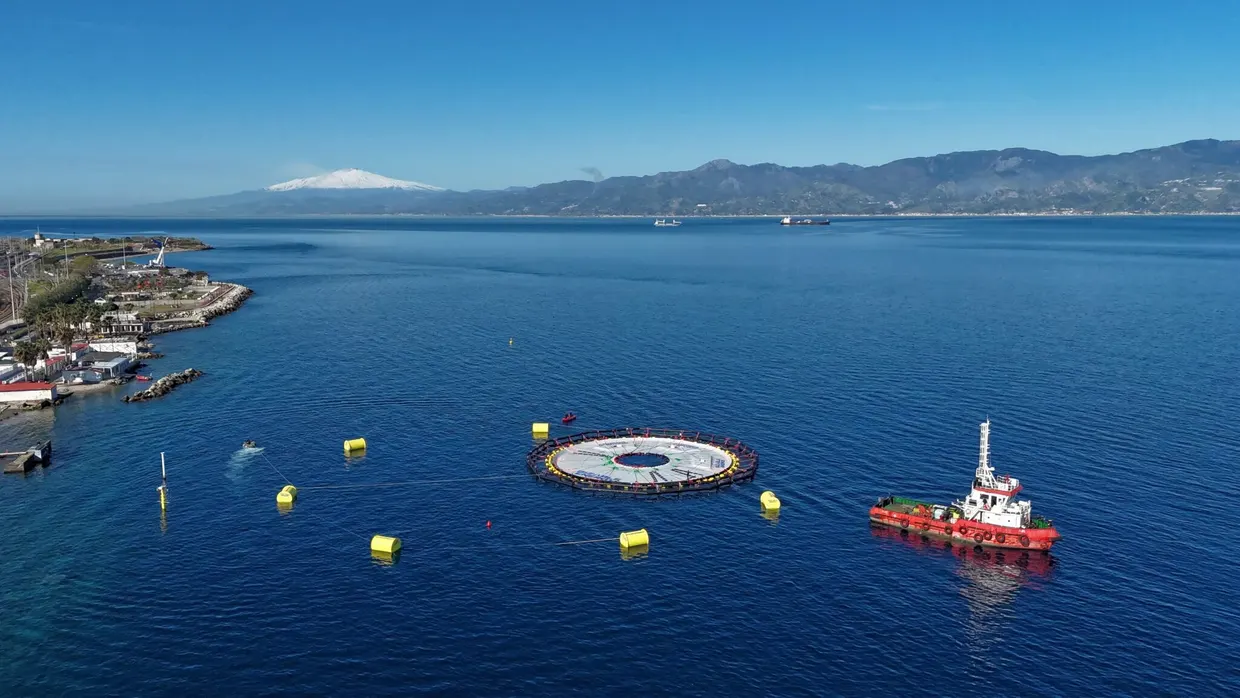
Italian company Sizable Energy is developing an offshore gravity-based energy storage system that uses seawater depth and high-density brine, co-founder Simone Biondi told pv magazine Italia, as reported by pv-magazine.com. The company completed offshore tests in Reggio Calabria with the University of Reggio Calabria, after earlier tank tests at the Dutch marine research institute Marin pv-magazine.com
pv-magazine.compv-magazine.comOpen source ↗.
According to the company, the tests validated key components under real conditions and showed that deployment can be done without specialized vessels. Over the past year the company moved from the demonstration and concept-validation phase to project development.
How the system works
The design applies the pumped hydro principle at sea. It uses flexible reservoirs on the seabed and at the surface instead of reservoirs at different elevations on land. When surplus electricity is available, pumps move brine from the seabed reservoir to a floating reservoir at the surface. When power is needed, the brine flows back down through a turbine.
The company describes the system as closed-loop, built from commonly available materials, with no lithium and no land use. Power output depends on water depth and the number of machines, while storage capacity depends on reservoir volume and depth, so the two can be sized independently pv-magazine.com
pv-magazine.compv-magazine.comOpen source ↗.
The site requires water at least 500 meters deep and reasonable proximity to the coast and grid. Sizable Energy estimates a service life of more than 30 years without cycle-related degradation, versus the 10 to 15 years it attributes to conventional batteries. Biondi describes lithium-ion systems as complementary, and says the technology targets utility-scale projects in gigawatt-hours.
Projects and next steps
The company has received the European Commission's STEP Seal and secured additional funding for an integrated demonstrator with a data center in Naples, scheduled for the first half of 2027. Pre-FEED and FEED work is underway for an initial project in Calabria and a second in Sicily.
Biondi said the company has a pipeline of more than 10 GWh of potential projects in the Mediterranean and Middle East, with advanced discussions in the Caribbean. The platform is designed to integrate with floating solar and offshore wind, sharing moorings and grid cables. Its Power Shell concept combines storage, floating solar and data centers on one platform pv-magazine.com
pv-magazine.compv-magazine.comOpen source ↗.
Biondi acknowledged that the technology is at a first-of-a-kind stage. Although it uses components already deployed in the offshore industry, integrating them into a new architecture carries technical risks that must be addressed through field demonstrations. In Italy, he named Terna's Macse mechanism, which provides long-term storage contracts, as a possible framework for grid-connected projects.